
Decision AI is the engine. GenAI is the interface. Agents are the operators.

I’ve been in this industry long enough to see the cycle repeat itself.
Every few years, we don’t just build new technology—we rebrand foundational ideas and call them revolutionary. In the ‘90s, it was e-business. Then cloud. Then big data and digital transformation. Now, everything is AI.
I’m not saying this cynically. This is just how our industry evolves. But underneath the rebranding, there’s something real happening—and most people are missing it.
The stack that actually matters
Here’s the cleanest way I can explain the modern AI architecture:
Decision AI is the engine. This is the layer that actually makes predictions and business decisions. It classifies (is this transaction fraud?), estimates (what’s the demand next quarter?), prioritizes (which customer issues need attention first?), and discovers (what behavioral segments exist in our data?). This is where the real economic value lives.
GenAI is the interface. It lets humans talk to systems in natural language, explains outputs in plain English, and makes complex models accessible. GenAI doesn’t decide—it communicates. It translates.
Agents are the operators. They orchestrate workflows, route requests to the right systems, and turn decisions into actions. They don’t create predictions. They execute on them.
Think of it this way: Decision AI is the engine of the car. GenAI is the dashboard and steering wheel. Agents are the driver and the cruise control. A sleeker dashboard doesn’t make a weak engine powerful.
Four patterns run almost everything
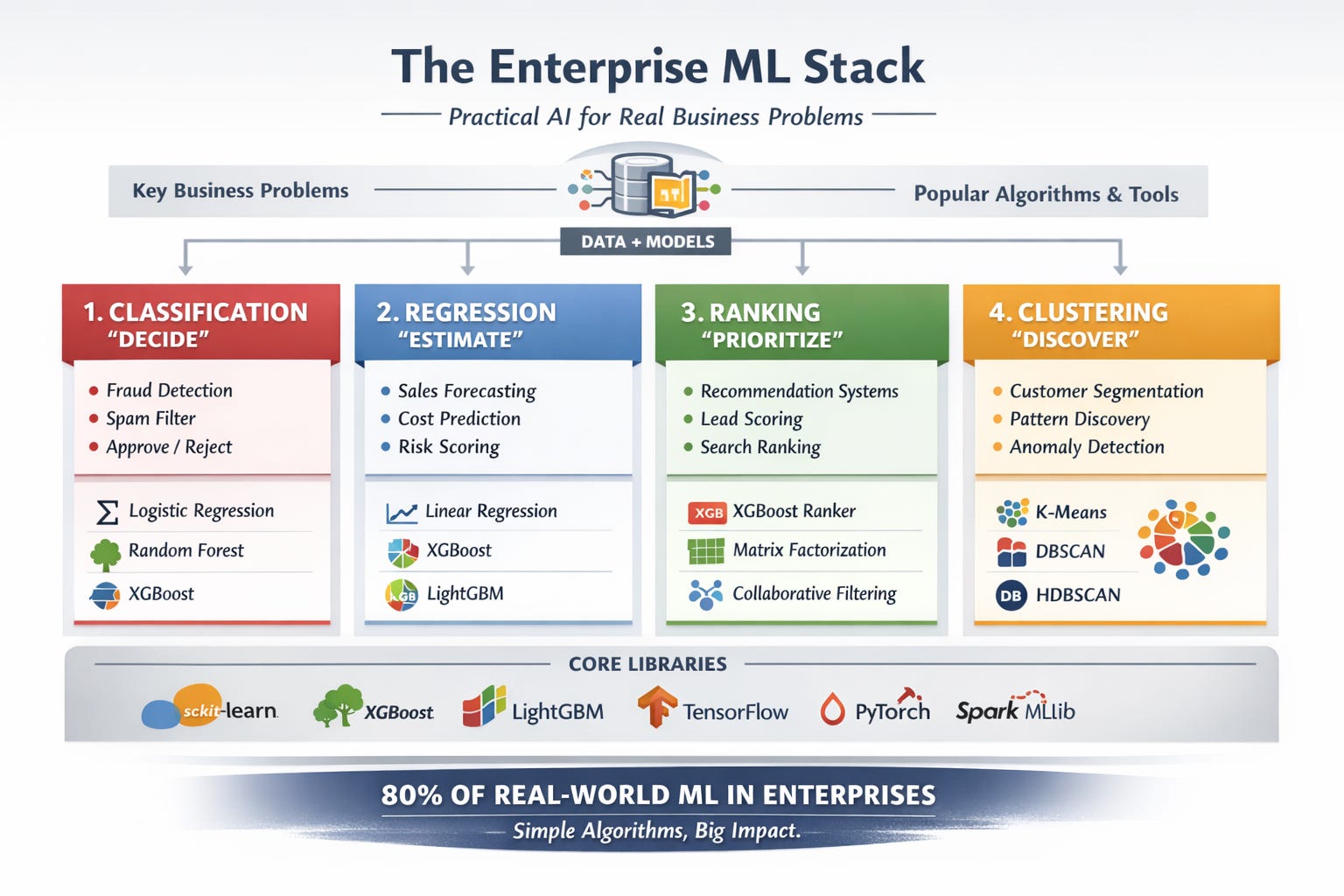
Across banking, retail, media, and enterprise platforms, I’ve noticed something: nearly all the business value from machine learning comes from just four core patterns.
Classification → Decides Your bank flagging a suspicious charge.
Regression → Estimates Zillow predicting the price of your home.
Ranking → Recommends Netflix choosing what to show you next.
Clustering → Discovers Retailers segmenting customers by purchase behavior.
That’s it. Almost every “AI use case” in an enterprise is one of these four patterns dressed up differently. Everything else is orchestration, UX, and plumbing. Refer to the diagram above for some common use-cases and algorithms associated with each pattern.
How it actually flows
In a well-designed enterprise system, the flow looks like this:
A user asks a question through GenAI. An agent interprets intent and routes the request. The decision model runs. GenAI explains the result in natural language. The agent triggers the next action—maybe an approval, an alert, or another API call.
GenAI doesn’t replace Decision AI. It amplifies it. And here’s the uncomfortable truth most vendors won’t tell you: if your Decision AI layer is weak, GenAI just helps you make bad decisions faster—with better explanations.
That’s not transformation. That’s automating mediocrity.
The real opportunity hiding in plain sight
Most companies don’t actually have an “AI problem.” They have processes that are still manual: approvals, triage, forecasting, prioritization, routing. Every single one of these is a Decision AI opportunity waiting to be solved.
But here’s the strategic mistake I’m seeing right now: companies are investing in the interface before fixing the engine. The result? Great demos. Excited executives. Very average outcomes.
I’ve seen this play out too many times. A company rolls out a beautiful GenAI chatbot that can answer questions about policies or pull up dashboards. Everyone loves it. But underneath, the decisions are still being made by outdated rules, gut instinct, or models that haven’t been retrained in years. The chatbot just makes it easier to interact with broken logic.
Who wins the next decade
The next ten years won’t be won by whoever has the best chatbot. It will be won by whoever has the sharpest decision engines.
If your fraud model can’t accurately separate real threats from false positives, a conversational interface won’t fix that. If your demand forecasts are consistently off, explaining them in plain English doesn’t make them useful. If your recommendation engine can’t personalize at scale, wrapping it in a chat experience is just lipstick on a pig.
Most companies right now are upgrading how they talk to their systems. The winners will be the ones who upgrade how their systems decide.
Fix the engine first. Then build the interface. Then add the orchestration. In that order.
Because at the end of the day, business value doesn’t come from better conversations with your technology. It comes from better decisions, made faster, at scale. And that’s not a GenAI problem. That’s a Decision AI problem.
#EnterpriseAI #DecisionAI #GenAI #AIAgents #AIStrategy #EnterpriseArchitecture #DigitalTransformation #MachineLearning #TechLeadership #CIO #CTO #PragmaticArchitect